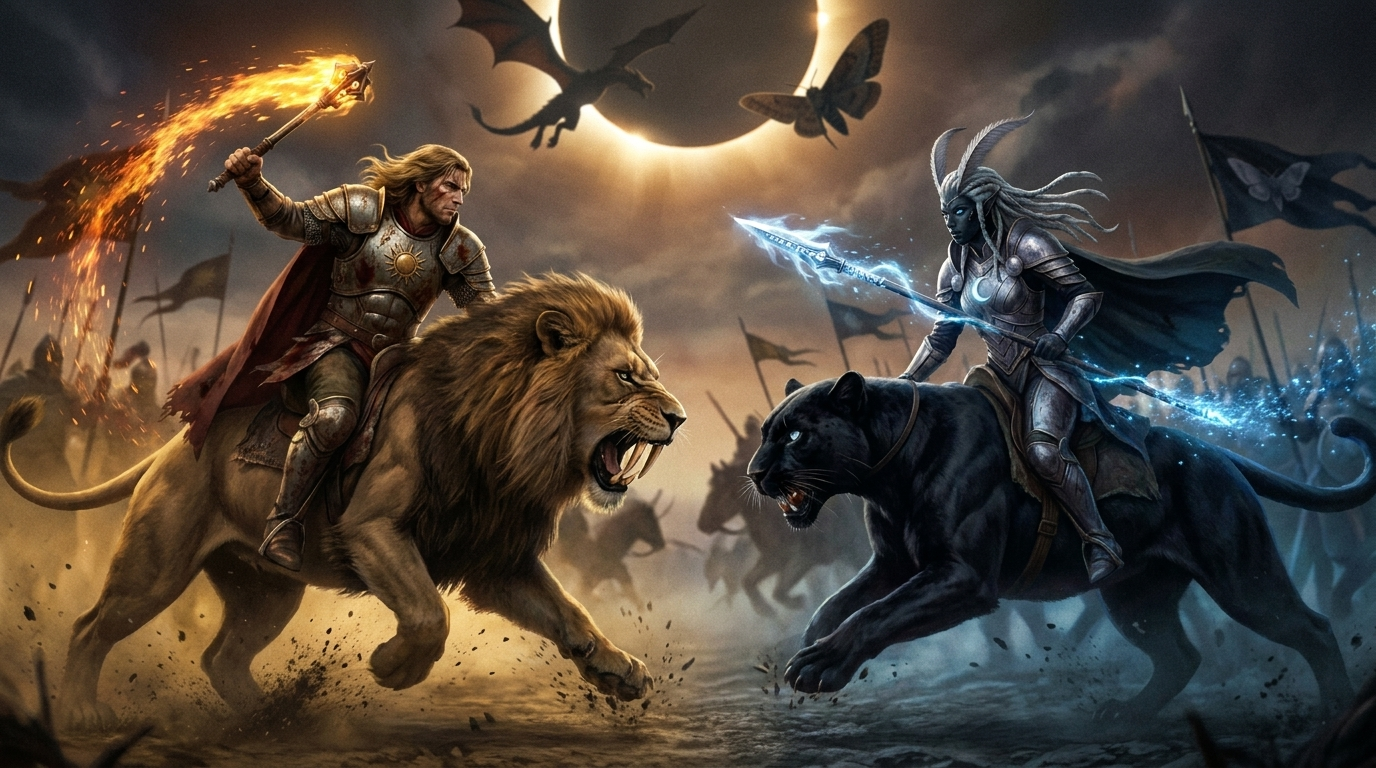
How to Play Sol Ultimus: The Eclipse War
Controls, gold, buildings, army, hero and the turning sky, in the order you need them.
You play Sol Ultimus: The Eclipse War in a browser tab at solultimus.com: you pick a mode, select units with the left mouse button, give orders with the right, put workers on gold mines, upgrade your fort, recruit an army and bring down the enemy citadel. It is a real-time strategy game between the humans of the Sun Order and the Moon Elves. It is free, it needs no download and no account, and it starts the moment the page loads. A skirmish hands you a hero, a fort and an empty field. Everything after that you pay for out of the gold your workers dig. The 21-chapter campaign teaches the parts one at a time, the skirmish against the computer and the online 1v1 put all of them on the table at once, and the Arena Duel skips the economy and drops three fighters of your choosing into an orc pit.
The two peoples differ in faces, buildings and which half of the day favours them, not in numbers. Both sides field the same values behind their own models.
The campaign, 21 chapters, from carrying a dragon egg out of a mire to the orc arena. Each chapter has its own objective, its own map and often its own clock. Your progress is saved in your browser as you win.
A 1v1 skirmish against the AI, in easy, normal or hard, on the Standard Battlefield or the wider Great Plains. The standard map holds two keeps, four gold mines, three dragon roosts and three guarded treasure chests on the diagonal between you.
The same skirmish against a person. The game opens a room and puts the invite link in the address bar. Share the link and your opponent drops straight into your match.
No base and no economy. You pick three fighters out of the heroes, the champions and the troops. They start on the altar in the orc pit, and a gate grinds open ten seconds later, or the moment one of them steps off the stone. Choose a single three-against-three duel, or the gauntlet of four duels that get harder each round. The altar heals whoever stands in its light.
Selecting is done with the left button. One click takes the unit you clicked, two clicks take every unit of that type on screen, three clicks take your whole army. Drag a box to grab a group. Hold Shift and click to add one more, or to drop one you already had.
Ordering is done with the right button. Right-click the ground to move there, an enemy to attack it, a gold mine to work it, a dragon roost to tame it. Right-click one of your own wall sections with archers selected and they climb onto the walkway. Right-click with nothing armed and nothing selected does nothing, so you can never misfire.
On a phone or tablet the same game runs on touch. Tap to select, tap again to order, drag one finger to move the camera, pinch with two to zoom. On-screen buttons jump to your hero, arm box-select, grab your whole army and recall four colour-coded troop groups.
| Input | What it does |
|---|---|
| Left-click | Select. Once for that unit, twice for all of that type on screen, three times for your whole army |
| Left-drag | Draw a selection box |
| Shift + left-click | Add one unit to the selection, or remove it |
| Right-click | Move, attack, capture a mine, tame a roost, climb a wall |
| Ctrl + click (or Cmd) | Your selection follows that soldier |
| Middle-mouse drag, arrow keys, screen edges | Pan the camera |
| Mouse wheel | Zoom in and out |
| F1 | Select your hero and jump the camera to him |
| F2 | Select your whole army, workers stay behind |
| Space | Jump the camera to the last thing that happened |
| A | Attack-move, then click the ground |
| M | Move, then click the ground |
| S | Stop |
| H | Hold ground |
| B | Build, with a worker selected |
| Q, W, E, R | Your hero's four abilities |
| X | The rank 9 ultimate |
| 1 to 5 | Recall a control group, tap twice to jump the camera to it |
| Ctrl + 1 to 5 | Save the current selection as that group, the numpad works the same |
| Tab (hold) | Scoreboard |
| T | Chat |
| Esc | Cancel an armed order, or open the menu |
A skirmish starts you with 300 gold, your hero, three men-at-arms and three workers already standing at the nearest gold mine. Nothing pays out until a mine is yours.
To take a mine, stand any unit within about four paces of it with no enemy that close, and after five seconds it flies your colours. Then click the mine with workers selected to put them to work. Each mine holds 6000 gold; when it is empty it goes back to belonging to nobody, so plan the next one before the first runs out.
Supply is the second budget. Every soldier costs supply points and the cap is 21 per commander. Your hero and your dragon cost none. Campaign chapters can set their own cap. Your fort holds at most five recruits in the queue, and cancelling one refunds the gold in full.
| Source | What it pays |
|---|---|
| Holding at least one mine that still has gold | +2 gold per second |
| Each gold mine you own | +3 gold per second |
| Each worker digging at that mine, five at most | +1 gold per second each |
| Loot from wolves, bandits, drakes, dragons and fallen heroes | Walk any unit over it to pick it up |
Your fort has three tiers: a timber fort, a stone fort, then the great citadel. You upgrade by selecting the fort and paying. The stone step also raises a ring wall around it with a gate and four corner towers that shoot.
Workers build watchtowers, but only inside the circle around your citadel or your shrine, never in water and never on top of something else. A worker standing beside a damaged building repairs it. A tower being upgraded stops shooting until the work is finished, so upgrade before the wave arrives, not during it.
The forge at your fort sells two one-off improvements: Better Armor, in two steps, and Alchemist's Fire for your catapults.
| Building or upgrade | Cost | What you get |
|---|---|---|
| Timber fort | you start with it | Workers, men-at-arms, archers |
| Stone fort | 400 gold, 60 seconds | Knights, clerics, catapults and ballistas, plus a ring wall with a gate and four corner towers |
| Great citadel | 300 gold, 90 seconds | The war rhino or dire boar, the battle cat, and the right to build a shrine |
| Watchtower | 100 gold | 300 health, 12 damage, range 10. Seven at most: two at the start and five of your own |
| Tower upgrade | 150 gold, then 190 gold | Stone, then reinforced. 24 and 36 seconds, and it does not shoot while the work runs |
| Shrine | 320 gold | 900 health. This is where a fallen hero returns, for 250 gold and 30 seconds. One per commander |
| Better Armor I and II | 150 gold, then 300 gold | Everything you own takes 9 percent, then 18 percent, less damage |
| Alchemist's Fire | 250 gold | Every catapult gains a burning boulder |
Select your fort and click a portrait to recruit. What you can build depends on the tier your fort has reached, so the shape of your army is really a question of how fast you upgraded.
The triangle holds for both peoples. The Moth Warden of the Moon Elves counts as a man-at-arms, her archer as an archer, her Moth Master as a knight. Nobody gets a bonus the other side does not.
The fourth axis matters most. Archers are the only real answer to a war rhino, a dire boar, a battle cat, a bear, a cave troll, a cyclops or a dragon. An army with no archers in it has nothing to say to a war beast.
Pikes stop riders. Four men-at-arms cost 400 gold and take a 300-gold knight off the field quickly.
A knight is not there to grind against a shield wall. He is there to get around it and reach the bows behind it.
Arrows find the gaps in a shield wall. Archers behind your own front line answer theirs.
War beasts, battle cats, bears, cave trolls, cyclopes and every dragon. The catapult carries the same bonus against them.
| Unit | Gold | Supply | Needs | Role |
|---|---|---|---|---|
| Worker | 50 | 1 | Timber fort | Digs gold, builds towers and shrines, repairs buildings |
| Man-at-Arms | 100 | 1 | Timber fort | The front line. 2.0x damage against knights |
| Archer | 120 | 1 | Timber fort | Range 8. 1.75x against men-at-arms, 1.8x against thick hides |
| Cleric | 180 | 1 | Stone fort | Heals wounded allies nearby. No attack |
| Knight | 300 | 2 | Stone fort | Heavy hitter. 1.75x against archers |
| Catapult | 300 | 3 | Stone fort | Range 14, further than any tower. 2.5x against buildings, 1.8x against thick hides. Needs a crewman on board |
| Ballista | 300 | 3 | Stone fort | Range 16, one bolt, no splash. 1.9x against infantry, archers and knights. Needs a crewman on board |
| War Rhino or Dire Boar | 550 | 4 | Great citadel | 1400 and 1300 health. Crushes buildings and troops, and carries two soldiers on its back |
| Battle Cat or Panther | 750 | 4 | Great citadel | The fastest thing on four legs. One per commander, and your hero can ride it |
You lead one hero. For the humans that is the Paladin of the Sun Order with his mace; the Moon Elves field their own champion with the spear. He starts at 350 health and 30 damage and gains a rank by fighting, and he carries the items he finds from one chapter into the next.
In the campaign he learns his workings one at a time: Smite from the treasure chest in chapter 1, Healing Light from the cleric in chapter 6, Aegis of Light from the seer at the bridge in chapter 10, and Ascendant from the seer in your fort in chapter 16.
His death is not free. In a campaign chapter, losing your hero or your companion dragon ends the chapter there, unless a shrine of yours is standing. With a shrine standing you call him back for 250 gold and 30 seconds.
| Key | Humans | Moon Elves | What it does | Cooldown |
|---|---|---|---|---|
| Q | Smite | Shadow Rend | Strikes the nearest enemy within 4.5 for 2.5x his weapon damage | 9 s |
| W | Healing Light | Life Drain | Humans heal every ally within 12 for 90, plus a short afterglow. Moon Elves tear 70 from the nearest enemy and hand 70 to every ally within 12 | 24 s |
| E | Aegis of Light | Veil of Shadows | Five seconds in which nothing gets through. He can raise it even while knocked senseless | 75 s |
| R | Ascendant | Avatar of Night | Twenty seconds as a giant: double damage, far harder to wound, health restored in full. Needs rank 6 | 140 s |
Outside the campaign the sky turns every six minutes: six minutes of day, then six minutes of night, over and over. The orb in the top bar shows which hour it is and counts down to the turn.
Under the sun the humans deal 5 percent more damage and see 10 percent further. Under the moon the Moon Elves get exactly the same. The bonus counts against walls and towers as well as against troops, so the hour you choose to attack a fort is a real decision.
Campaign chapters pin the sky instead of turning it, and in most of them the mirror holds: a chapter that is night for the humans is day for the Moon Elves. A handful hang the same sky over both peoples, chapters 2, 3, 4 and 5 being night for everyone and the orc arena of chapter 21 broad day for everyone. Chapter 15 breaks it outright. Night falls and does not lift, your soldiers away from the torch ring around your own keep see a little over half as far, and the other side hits 25 percent harder. Play the Moon Elves and it is a sun that never sets instead.
Put your three workers on the nearest gold mine and leave them there. Each one is a gold a second and they are the only reason anything else happens.
Send a man-at-arms to stand on a second mine. It takes five seconds of standing there, and every mine you hold is another three gold a second before a single worker digs in it.
Recruit men-at-arms and archers from the fort while the gold comes in. Men-at-arms in front, archers behind. One cleric later turns a straight trade of blows into one you win.
Upgrade the fort to stone as soon as you can carry 400 gold. That is the step that opens knights, clerics, catapults and ballistas, and it walls your fort in.
Take your hero out to clear a wolf or bandit camp. He levels on the kills, the camp drops gold and runes, and Ascendant only unlocks at rank 6.
Keep upgrading to the great citadel: that is what opens the war beast and the battle cat. A shrine already stands beside your keep in a skirmish, and that is where a fallen hero comes back, for 250 gold and 30 seconds.
Fight at home when you can. Three wardstones stand around every keep, each one giving your army 5 percent more damage, and standing within 11 paces of one heals 2.2 health a second. Defending really is stronger here than attacking.
No, Sol Ultimus: The Eclipse War runs entirely in your browser with no download, no installer and no plug-in. You open solultimus.com, type a nickname and play. The whole game is a web page built with three.js, so anything that can draw 3D in a browser can run it.
Yes, Sol Ultimus: The Eclipse War plays on a phone or tablet with a full set of touch controls. Tap to select, tap again to give the order, drag one finger to move the camera, pinch with two to zoom. On-screen buttons jump to your hero, arm box-select, grab your whole army and recall four troop groups. The game also installs to a home screen through your browser's add-to-home-screen option and opens full screen in landscape.
No, Sol Ultimus: The Eclipse War needs an internet connection for every mode, including the single-player campaign. The rules run on the game server at ten ticks a second and your browser is the screen and the controls, so there is nothing to simulate locally. Your campaign progress, on the other hand, is stored in your own browser, so it is there when you come back.
A campaign chapter of Sol Ultimus: The Eclipse War runs from a few minutes to a quarter of an hour, and nine of the twenty-one chapters are built around a clock. Chapter 2 asks for three minutes at the nest, chapter 4 for five at the fort, chapter 15 for fifteen under a broken sky; the rest end when their objective is done. A skirmish against the computer and an online 1v1 have no clock at all: they end when a citadel falls.
No, Sol Ultimus: The Eclipse War asks for nothing but a nickname, and there is no sign-up, no login and no payment anywhere in it. Your chapter progress, your name, your chosen hero and the items he carries live in your own browser. Clearing your browser data clears them with it.
Not from the menu as the game stands: the people picker sits in the page but is not shown, so a match starts you as the humans of the Sun Order and puts the Moon Elves on the other side. The mirror campaign is fully built behind it all the same, the same 21 chapters with the sides swapped, the same values behind different models, and a flipped sky in every chapter that mirrors, so a chapter that is night for the humans is broad day for the Moon Elves.